
Key Takeaways
A super jeep is most useful when changing weather and cloud cover make a fixed route less practical. The value comes from guided local judgment, access to darker landscapes, and a more personal way to spend the evening.
- A high-clearance vehicle can reach more remote viewpoints when conditions allow.
- Small guided groups make it easier to adjust the route during the evening.
- Darker surroundings outside Reykjavík improve the setting for aurora viewing.
- Winter weather can change quickly, so local knowledge matters as much as the vehicle.
- A super jeep costs more, but the flexibility suits photographers and visitors with only a night or two.
Before the general advice, the specifics of our own version. Our Super Jeep Northern Lights tour runs late August to mid April, with hotel pickup in Reykjavík between 20:00 and 21:00 and three to four hours out in the dark. Groups are 8 to 12 people, prices start at 14,900 ISK, and if the sky gives you nothing you get free rebooking until you see them. Blankets, hot chocolate and Icelandic chocolate come with it.
What makes a super jeep different from a standard tour vehicle
A super jeep is built for Icelandic roads and changing terrain, while a standard tour vehicle is generally intended for established routes. That difference does not guarantee an aurora sighting, but it can give a guide more options when selecting a viewpoint. For many visitors, the appeal is less about speed and more about reaching a quiet place comfortably with a small group.
High clearance for rough roads and remote viewpoints
High clearance gives a vehicle more room over uneven surfaces, ruts, and snow when a suitable route is open. A guide can consider viewpoints that would be awkward for a lower vehicle, always within the limits of the road and current conditions. The point is not to drive anywhere at random. It is to have a capable vehicle while a local driver makes the route decision.
Smaller groups and more flexible routing
A small group is easier to brief, move outdoors, and gather again when the weather turns. The guide can explain why the route is changing rather than following a large coach timetable. This personal rhythm is one reason a guided trip can feel calmer, even when the evening itself is weather dependent.
Better access to dark locations outside Reykjavík
Leaving the capital reduces the glow that can wash out a faint aurora. A super jeep may help a guide reach a darker roadside viewpoint or open landscape, but darkness is only one part of the equation. Clouds, aurora activity, wind, and safe road access still decide whether a stop is worthwhile.
That is what our Super Jeep Northern Lights tour is built around: a vehicle that widens the options, and a guide who still has to make the call.
How the vehicle handles Iceland’s winter conditions
A big vehicle is one input. Tires, visibility, wind and the judgment of the person driving are the others, and the last one carries the most weight. Expect the route to change when snow or ice changes the road. No viewpoint is worth a bad drive home.
How a super jeep improves your chances of seeing the aurora
Ask why a super jeep for aurora hunting is worth it and you are really asking about options. The northern lights are a natural phenomenon, so no vehicle can promise a display. What a guided super jeep trip can do is help the driver respond to the night’s combination of darkness, cloud cover, forecasts, and road access.
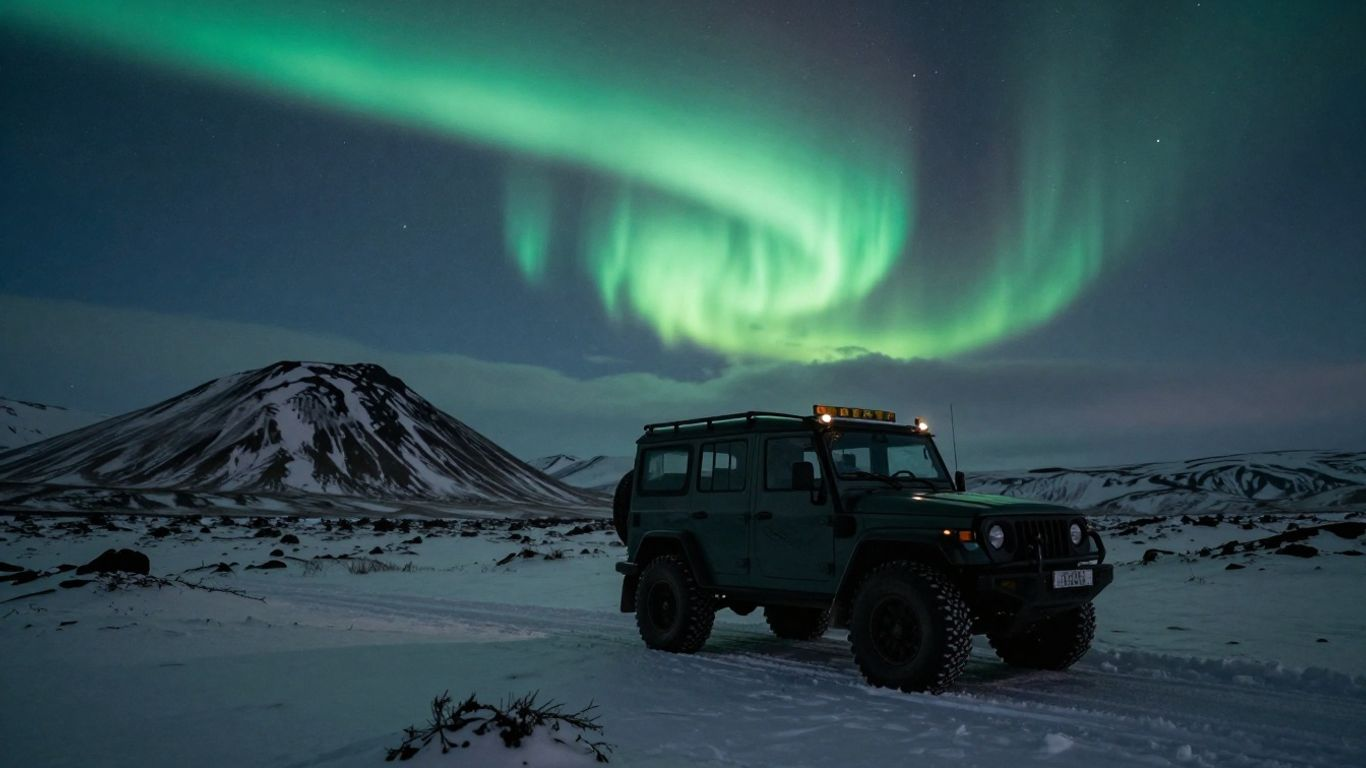
Chasing clear skies instead of staying in one place
Cloud cover can be completely different half an hour down the road. Rather than waiting at one fixed stop for the whole evening, a guide may look for a clearer area that remains practical and safe to reach. That movement is useful when the forecast suggests openings nearby, though it remains subject to conditions on the ground.
Reading cloud cover, forecasts, and aurora activity
A good aurora evening begins with interpretation, not just a departure time. Guides consider cloud forecasts and aurora activity alongside visibility, wind, and the condition of the roads. Our guides do this every night of the season, reading live cloud maps and aurora forecasts against what the sky is actually doing before deciding where the jeep goes.
The Northern Lights guide is useful preparation because it brings together viewing conditions, timing, clothing, and photography considerations before the tour begins. Local judgment matters most when several forecasts appear promising but the actual sky tells a different story.
Escaping light pollution around the capital
Reykjavík is convenient for pickup and unhelpful for everything after that. City light washes out a faint aurora long before your eyes have adjusted to the dark. Thirty or forty minutes out, the sky opens up and colors you would have missed entirely become obvious. You also get there without driving an unfamiliar Icelandic road in the dark yourself, which is not nothing.
Why flexibility matters when conditions change quickly
An evening route can change because a cloud bank moves in, wind increases, or a road becomes less suitable. That is a normal part of aurora hunting rather than a sign that the plan has failed. The guide’s job is to weigh those changes and choose whether to continue, relocate, wait, or return.
A flexible route improves the opportunity to look, but it never changes the basic uncertainty of the aurora. The best experience leaves room for patience as well as movement.
The best places to go aurora hunting from Reykjavík
There is no single best aurora stop for every night from Reykjavík. The right choice depends on cloud patterns, road conditions, wind, darkness, and how far the group can travel safely. A local guide can select from open landscapes, coastal areas, or mountain viewpoints without promising that a particular landmark will produce better lights.
Dark-sky areas within a practical driving range
The first priority is usually a place with less artificial light and a broad view of the sky. It may be close to the capital on one night and farther away on another. Practical driving range matters because the group needs time to stop, look up, and return safely rather than spending the entire tour in transit.
Mountain roads, coastal viewpoints, and open landscapes
Each landscape creates a different foreground for photographs. Mountains can frame the sky, a coast can give a low open horizon, and a field can provide a simple view in several directions. The guide chooses what fits the conditions, since scenery alone does not make a location suitable for an aurora stop.
Seasonal road access and winter closures
A road that looks fine on a map can be a bad idea in February. Temporary closures, snow, ice, and wind can remove a viewpoint from consideration without warning. A guided small-group tour keeps the decision with someone who is checking the current situation rather than relying on a summer memory of the road.
Balancing scenic views with a safe return route
A good stop must work in both directions. It should offer a useful view while leaving enough margin for changing weather and the journey back to Reykjavík. This is where a local guide’s knowledge can be more valuable than a longer list of possible destinations.
What the experience is like during an aurora tour
An aurora tour is mostly driving, waiting, talking, and short cold bursts outside. Sometimes the lights turn up within twenty minutes. Sometimes you stand in a field at half past midnight looking at nothing while your guide checks the cloud map again. The jeep is the warm base you keep coming back to, and the main job of the guide between stops is telling you when it is actually worth getting out.
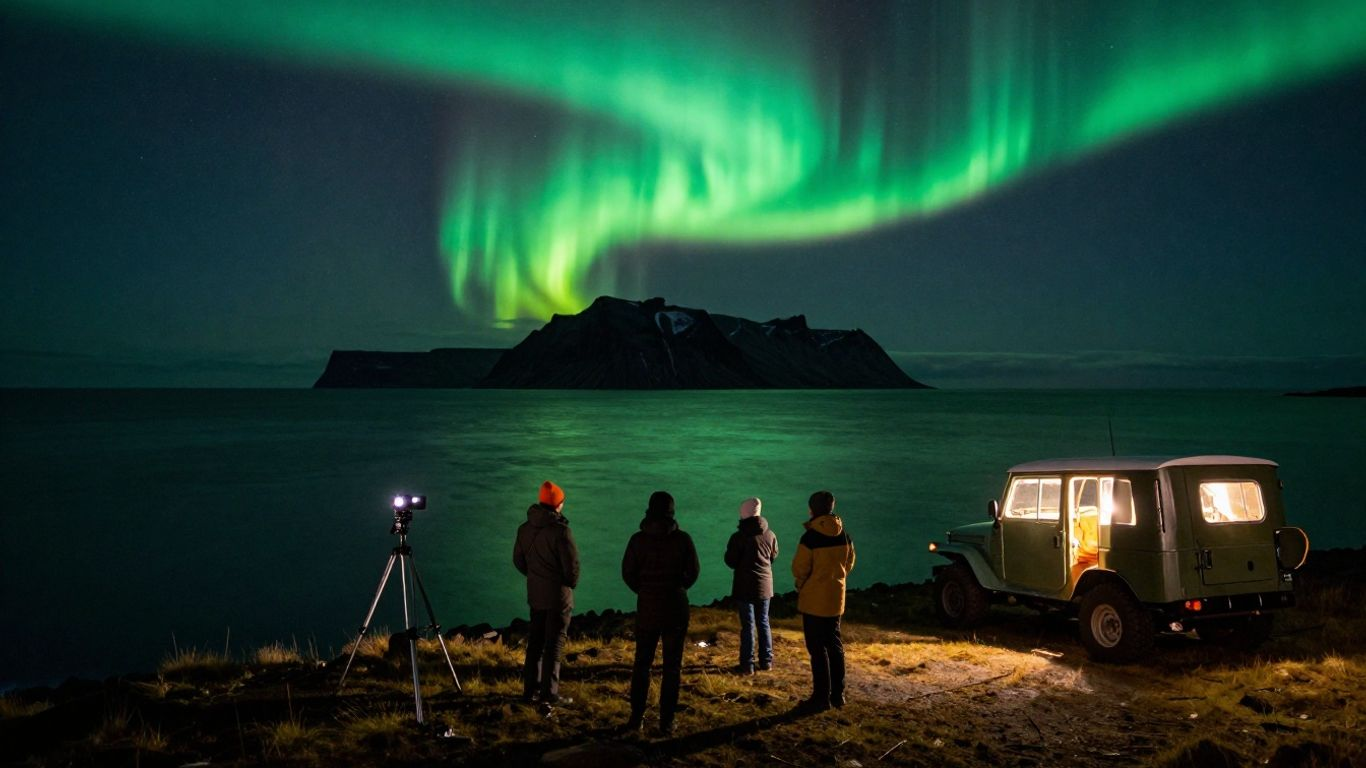
Warm clothing, heated cabins, and time spent outdoors
A heated cabin is welcome between viewing stops, but passengers should still dress for time outside. Icelandic winter air can feel sharp, especially with wind, and standing still for photographs makes cold arrive sooner. Layers, a waterproof outer shell, warm socks, gloves, and a hat are more useful than relying on the vehicle’s heating alone.
Setting up for photos without disturbing other visitors
Aurora photography takes a little preparation. A tripod, spare battery, and a camera that allows manual control can make the process easier, while a phone can still record a personal memory. Keep light pointed down when possible and follow the guide’s advice so one person’s headlamp or screen does not spoil another group’s view.
Local stories, landmarks, and guidance from the driver
The drive is part of the evening, not merely transport between stops. An all-Icelandic guide can add context about the landscape, local weather, and the changing route in a way that makes the waiting feel purposeful. If the camera matters more to you than the vehicle, our Northern Lights Photo Tour covers the same season from 9,900 ISK and puts the emphasis on getting your settings right.
What to bring for comfort and better pictures
Packing lightly is sensible, but a few items make a real difference. A small camera bag should leave room for personal layers and should not become a burden when walking over uneven ground. These are the most useful additions for most guests:
- A tripod or stable support for long exposures.
- Spare batteries or a fully charged power bank, because cold drains them fast.
- Waterproof outer layers and warm footwear.
- A small flashlight with a red-light setting if available.
The Iceland packing list offers broader clothing guidance for changing conditions. Bring only equipment you know how to use, because a simple well-prepared setup is easier to manage in the dark.
Safety and weather considerations for a super jeep trip
Icelandic winter weather changes faster than your plans do. A super jeep is helpful equipment, but it does not remove the risks of wind, ice, poor visibility, or sudden road changes. The safest trip is one where the guide treats the forecast as useful information, not as permission to continue regardless of what appears outside.
Why Icelandic winter weather requires local expertise
Weather can affect the road, the vehicle, and the time needed to return. Local expertise helps connect the forecast with the actual landscape, including exposed stretches where wind may be stronger than it feels in Reykjavík. This is a central reason to choose a guided tour rather than attempting to manage an unfamiliar winter route alone.
Checking road conditions before leaving Reykjavík
The route is checked before departure and reassessed all evening. Drivers consider closures, surface conditions, visibility, and wind before committing to a remote viewpoint. Guests can help by listening to instructions, staying with the group, and asking when a stop involves slippery or uneven ground.
Knowing when a route should be changed or canceled
Sometimes the correct decision is to shorten the route, move to a different area, or cancel the outing. The aurora is never worth an avoidable risk. A clear cancellation and rebooking policy also matters, particularly because cloud and weather can prevent useful viewing even when activity is forecast.
Staying safe on icy ground and remote roads
Walk slowly, use traction aids when advised, and keep clear of edges, water, and the vehicle. Darkness makes ordinary ground harder to judge, so follow the guide’s route instead of wandering off for a better photograph. Warmth matters too, and anyone becoming unwell or excessively cold should tell the guide immediately.
When a super jeep is worth the extra cost
The gap between our standard photo tour and the super jeep is 5,000 ISK. That is easiest to justify when flexibility and a small group are the point of the evening. It is less compelling if you mainly want a simple evening outside Reykjavík and are comfortable sharing a larger vehicle. The right choice depends on your group, photography plans, tolerance for uncertainty, and the amount of time available in Iceland.
Comparing a super jeep with a large coach tour
A coach can suit travelers who want a straightforward, often more economical outing with a larger group. A super jeep offers a different rhythm, with fewer passengers and more room for the guide to adjust the plan. Neither vehicle can control the clouds, so the comparison should focus on access, atmosphere, and flexibility rather than promises of a sighting.
Choosing a private trip versus a shared excursion
A shared guided excursion can be a good fit for solo travelers, couples, or small parties who enjoy meeting other visitors. A private tour gives one group more control over the pace and conversation. Our Private Northern Lights Photo Tour starts at 49,000 ISK for the whole group, which stops feeling extravagant surprisingly fast once there are four of you.
Situations where premium transport makes the biggest difference
A super jeep tends to make the most sense when the group values a quieter setting, wants more time for photography, or has only a few evenings available. It can also suit visitors who prefer an experienced driver to make winter route decisions. Those benefits are practical rather than guaranteed results, and the aurora remains dependent on nature.
When a standard northern lights tour may be enough
A standard tour may be enough if your budget is limited, your schedule allows another attempt, or you are happy with a larger group. It can still take you away from the city’s brightest lights and provide guidance during the search. Choosing the simpler option does not mean giving up the possibility of seeing the aurora.
How to choose the right super jeep aurora tour
Start by deciding what kind of evening you want, then inspect the details behind the tour name. A genuine guided experience should explain its pickup arrangements, group format, route flexibility, and approach to poor conditions. Read the inclusions carefully, because comfort items, photography help, and rebooking terms differ between operators.
Checking group size, pickup points, and tour duration
Confirm where pickup takes place and whether your accommodation is covered. Ask how many people normally travel together and how much of the evening is spent driving versus stopping outdoors. A clear description helps you choose a tour that matches your energy, mobility, and interest in photography.
Understanding what is included in the price
Look for the practical details first: transport, guiding, warm refreshments, blankets, photography assistance, and any retry or rebooking arrangement. Ours include free rebooking until you see the lights and free cancellation up to 24 hours before departure. That is a policy, not a promise that the first night will work, and you should read any operator version of it the same way.
Reviewing cancellation and rescheduling policies
Weather policies should be easy to find and written plainly. Check what happens when the operator cancels, when you need to change your date, and whether a rebooking has conditions. Since the aurora depends on darkness and clear enough skies, a fair policy is part of the value of the tour.
Choosing an operator with experienced local guides
A capable vehicle is only one part of the decision. Look for an operator that describes experienced local guides, small-group service, and a clear approach to forecasts and safety. We are a small Icelandic outfit, and the person driving is the person guiding. That is the whole reason the route can change at 22:40 without a phone call to an office.
Update for the 2026 to 2027 aurora season
Two things are worth knowing before you book this winter.
The sun passed the peak of Solar Cycle 25 in October 2024 and is now in the declining phase. That sounds like bad news and mostly is not. Fewer sunspots, yes, but several of the strongest geomagnetic storms on record arrived one to three years after a solar maximum, so the 2026 to 2027 season is still a good one to be standing in an Icelandic field at midnight. Be skeptical of anyone selling you the peak year. The peak was two years ago.
The second is closer to home. The Reykjanes peninsula has erupted repeatedly since 2021, the most recent episode ended in August 2025, and more are expected. It does not close Iceland and it does not close our tours. It can close specific roads at short notice, which is one more reason the route gets decided on the night rather than a week in advance. Official status is published on safetravel.is.
Conclusion
A super jeep buys you options: darker ground, a smaller group, and a guide who can change the plan at 23:00 because the cloud moved. It does not buy you the aurora. Nothing does. Book it for the access and the local judgment, then bring the patience, because that part is still on you.
Frequently Asked Questions
Is a super jeep necessary to see the northern lights?
No. The aurora can be visible from many settings when darkness, clear skies, and activity align. A super jeep mainly offers a smaller guided setting and more flexibility in choosing a suitable location.
Can a super jeep tour guarantee an aurora sighting?
No. Cloud cover, weather, and aurora activity are outside the operator’s control. Look for a clear cancellation, retry, or rebooking policy instead of a guaranteed-sighting claim.
What should I wear on a northern lights tour?
Wear warm layers with a waterproof outer shell, insulated footwear, gloves, and a hat. You may spend time outside waiting, even if the vehicle is heated between stops.
How far from Reykjavík do aurora tours travel?
The distance varies with the night’s weather, cloud cover, road conditions, and the guide’s judgment. The most useful location is not always the farthest one, since a safe return and time outdoors also matter.
Are northern lights tours suitable for children?
Suitability depends on the operator’s policy, the child’s comfort in cold weather, and the length of time spent outdoors. Ask about age requirements and prepare children for waiting as well as driving.
Is a private aurora tour better for photography?
It can be useful for travelers who want a more personal pace and more attention to camera setup. A private trip still cannot control the weather or guarantee that the lights will appear.
What happens if the lights do not appear?
Policies vary, so read the operator’s terms before booking. Some tours offer a retry or free rebooking arrangement, while others may simply conclude when conditions do not support further searching.